If you’ve spent any time online lately, you may have seen a video confidently explaining that many cat behaviours come down to whether your cat is male or female…based on science. And if you, like me, live with cats, you may have watched it with one eyebrow slowly rising.
Because cats, being cats, do not seem to have received the memo.
The Claim: “It’s Science!”
The video-style claims often go something like this:
- Male cats are more vocal.
- Male cats seek more attention.
- Male cats greet owners at the door.
- Male cats head-butt more.
- Female cats are more independent.
Hm. I currently have five feline co-habitants: three males and two females. One female and two of my males are the enthusiastic talkers and head-butters. A different female and another male are the official Door-Greeting Committee. In other words, my household looks less like a neat scientific chart and more like a feline improv troupe with strong individual opinions.
That is not just my experience. It is also much closer to what the research actually shows. Some of these ideas have a faint whisper of research behind them. But “a faint whisper of research” is not the same as “a reliable rule that applies to every cat.”
Cat behaviour research is complicated because cats are individuals, households differ enormously, and much of the evidence comes from owner questionnaires. If you ask people whether their cat is affectionate, you are partly measuring the cat, and partly measuring what the owner expects, notices, remembers, and interprets. In addition, many studies have quite small sample sizes, which means broad generalizations are a little tenuous.
So before we declare that all boy cats are fuzzy little extroverts and all girl cats are mysterious aloof introverts, let’s look at what studies have actually found.
What the Research Does Suggest
There are a few recurring findings, but they are modest, mixed, and heavily qualified. I have also included a few related claims that tend to get tossed into the same box.
| Claim | What the Research Suggests |
| Male cats are more vocal | Not consistently supported. One recent study found cats vocalized more to male human caregivers, regardless of the cat’s sex. |
| Male cats are more attention-seeking | Some studies report small differences in sociability or owner-rated closeness, but other research finds no cat-sex effect on affiliative behaviour. |
| Male cats greet owners at the door | Greeting is common in cats, but the evidence does not show that males uniquely do it. Tail-up approaches, rubbing, and vocalizing are part of familiar cat–human greetings. |
| Male cats head-butt more | Head-rubbing and allorubbing are affiliative behaviours, but research has not established a dependable male-only pattern. |
| Female cats are more independent (or less friendly) | Not supported as a general rule. One study of spayed and neutered indoor cats found no effect of the cat’s sex on affiliative or aggressive behaviour. |
| Male cats are more aggressive (or is it the females?) | Too blunt to be useful. Colony data show no overall sex difference, owner surveys are mixed, and one large analysis found neutered females rated as more aggressive than males. Context matters far more than sex. |
| Male cats roam and mark more | Yes, but mainly intact males. Intact males, especially those allowed outdoors, roam, urine mark, and fight with other males more. Neutering often reduces these behaviours. |
| Orange cats are friendly; torties have “tortitude” | Some interesting findings, but coat colour and sex are tangled together. (I’ll dissect this in a future article!) |
In short: a few real patterns do show up, but they are tied more to neuter status and outdoor access than to sex alone. The rest are not dependable enough to use as a cat-personality decoder ring.
The Vocalization Twist
Here’s the part I find especially satisfying. A 2026 study published in Ethology looked at 31 cats greeting their human caregivers at home. The researchers found that cats vocalized more frequently when greeting male caregivers (not male cats!) even after accounting for the cat’s sex, pedigree status, and number of cats in the household. That is almost the opposite of the viral claim.
Earlier studies, however, found that women and girls often speak to cats more often, and cats tend to vocalize more during those interactions. So what in cat’s name is going on?!
Well, one possible explanation in the 2026 study suggested was that if a male caregiver is less verbally interactive, a cat may respond by meowing more often or more insistently to get his attention. But that is an interpretation, not a proven cause. Remember, the study was small, took place in one country, and did not measure exactly how each caregiver normally spoke to or responded to their cat.
So what’s the verdict? A vocal cat cannot automatically be translated into male cat.
(My youngest, Samantha, could have told you that one!)
What about Head-Butting?
Head-butting, is actually more accurately called head bunting – but that’s just semanticsJ. Butting or bunting, it is one of those behaviours that feels deeply personal when your cat does it. Your cat presses his head against your hand, leg, face, or occasionally your coffee mug, as if to say, “Yes. This human belongs to me.” It is a real affiliative behaviour, and cats also raise their tails and rub against familiar people when greeting them after an absence, which researchers interpret as friendly intent.
But is it a dependable male-only pattern? Not one I would hang a blog post on. A study of indoor, spayed and neutered cats found no effect of the cat’s sex on affiliative behaviour, including amicable approaches and allorubbing.
Translation: your head-butter may be male. (I have two in my home.) Your head-butter may be female. (I have one very enthusiastic one of those, too!) Or your head-butter may be a small orange dictator with a very specific schedule.
Where Sex Does Matter: Intact Cats and the Great Outdoors
In fairness to the video I happened to see, there is one place where being male or female clearly matters: cats that are intact (not spayed or neutered) and allowed outside.
Intact males typically have a much larger territory and home base than intact females. With that bigger territory (and active hormones) comes a package of behaviours: more roaming, more sexual competition, more urine marking, and more fighting with other males. Neutering often reduces a lot if not all of these.
That is also why neuter status is often more behaviourally relevant than sex alone. It may even help explain the findings above, since some of those studies looked at spayed and neutered indoor cats, where much of what would otherwise separate males from females has already been switched off.
And What about Aggression?
It is tempting to stretch the territory story into generalizing that male cats are more aggressive, but…again the data just does not cooperate. In free-ranging cat colonies, one review reported no significant overall difference at all between males and females. In a few owner survey studies females actually scored higher. Sometimes. So the research to date is all over the place, at best.
From what we know today it seems that neuter status, socialization, pain, territory, handling, and who the aggression is aimed at matter much more than just sex.
Why Individual Cats Defy the Categories
Cats are not little personality vending machines where you insert “male” or “female” and receive a predictable temperament. As I always say, they, just like us, are individuals. And their behaviour is shaped by many things:
- Early socialization with people and other animals
- Genetics and breed tendencies
- Age
- Health and pain
- Neuter status
- Past experiences
- Household dynamics
- The relationship with each specific human
- Whether you have just opened a can of something suspiciously delicious
Research on cat personality emphasizes substantial individual variation, and studies of cat–human interaction have found that the cat’s sex often has little effect on the timing and pattern of interactions. No spreadsheet can fully explain cats. Believe me, I tried making one and failed. Miserably.
The Honest Version
None of this is a call to dismiss that there are some differences between our male and female fur-balls. Some research does suggest possible sex-related tendencies in cat behaviour, but the findings are mixed, often small, and overwhelmed by individual variation. Sex matters most in intact, free-roaming cats. Your cat’s personality is more complex than being determined by their chromosomes alone.
One Interesting Ripple….Coat Colour!
Now that said, there was one bit of interesting research I did find and that’s related to coat colour. This is where things get properly interesting, and a little tangled, because orange, tortoiseshell and calico colouring is sex-linked. And there have been some fascinating studies on coat colour and behaviour, where a few of the results surprised even me. But that’s for another article – so stay tuned!
A Gentler Way to Think About It
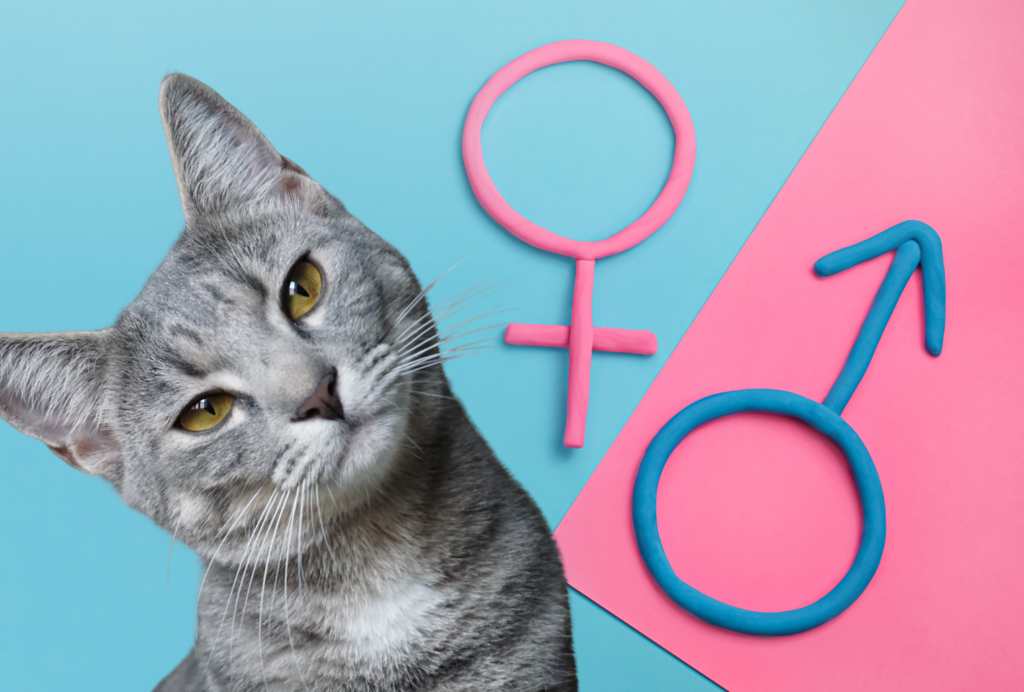
So what would I say in conclusion? Are male cats from Mars and females from Venus?
Well, I would rather redirect and look at your specific rent-free cohabitant. Instead of asking Is my cat acting like that because he is male (or because she is female)? perhaps the better question is What is Fluffy (or Max) telling me today?
A vocal cat may be asking for food, attention, reassurance, play, or access to a closed door that has suddenly become the most important door in the universe.
A cat who head-butts you may be showing affection, mixing scents, or simply informing you that your chin is now communal property.
A cat who greets you at the door may love you deeply. A cat who does not greet you at the door may also love you deeply…from a strategic distance.
And a cat who ignores every generalization ever written about cats, and behaves differently depending on the day, the weather, and the angle of the afternoon sun?
Well, congratulations. You have a cat.
_________________________________________
SOME CORE SOURCES
Demirbaş, Y. S., Kerman, K., Atılgan, D., Ünler, M., Yildirim, T., & Şimşek, S. (2026). Greeting vocalizations in domestic cats are more frequent with male caregivers. Ethology, 132(2), 87–94. https://doi.org/10.1111/eth.70033
Gajdoš Kmecová, N., Pet’ková, B., Kottferová, J., Wannell, R. S., & Mills, D. S. (2021). Potential risk factors for aggression and playfulness in cats: Examination of a pooling fallacy using Fe-BARQ as an example. Frontiers in Veterinary Science, 7, 545326. https://doi.org/10.3389/fvets.2020.545326
Leech, L., Preziosi, R., Stoycheva, R., & Pastorino, G. (2022). The effects of owner and domestic cat (Felis catus) demographics on cat personality traits. Applied Animal Behaviour Science, 248, 105570. https://doi.org/10.1016/j.applanim.2022.105570
Machado, D. de S., Vicentini, R. R., Gonçalves, L. da S., Luchesi, S., Otta, E., & Sant’Anna, A. C. (2025). Unraveling feline myths: A review about misperceptions and beliefs surrounding domestic cat behavior. Pets, 2(3), 32. https://doi.org/10.3390/pets2030032
Turner, D. C. (2021). The mechanics of social interactions between cats and their owners. Frontiers in Veterinary Science, 8, 650143. https://doi.org/10.3389/fvets.2021.650143
Turner, D. C. (2021). Unanswered questions and hypotheses about domestic cat behavior, ecology, and the cat–human relationship. Animals, 11(10), 2823. https://doi.org/10.3390/ani11102823
Urrutia, A., Bánszegi, O., Szenczi, P., & Hudson, R. (2023). Development of “personality” in the domestic cat: A longitudinal study. Developmental Psychobiology, 65(7), e22427. https://doi.org/10.1002/dev.22427