

Picture a quiet evening. The TV is off, the water heater has stopped rumbling, and the dishwasher has finished the evening shift. You could swear the house has finally settled into silence. Time for bed.
Meanwhile, your cat is staring at an empty corner, ears swivelling like two tiny satellite dishes.
Is the house haunted? Almost certainly not. It’s just very, very loud, and in a range of frequencies you left behind in childhood.
Welcome to the first deep-dive instalment of Cat Senses 101, where we step inside your cat’s world one sense at a time. First up: hearing, the sensory superpower that makes your cat both a brilliant hunter and, occasionally, a very confused housemate.
Your Ears vs. Theirs
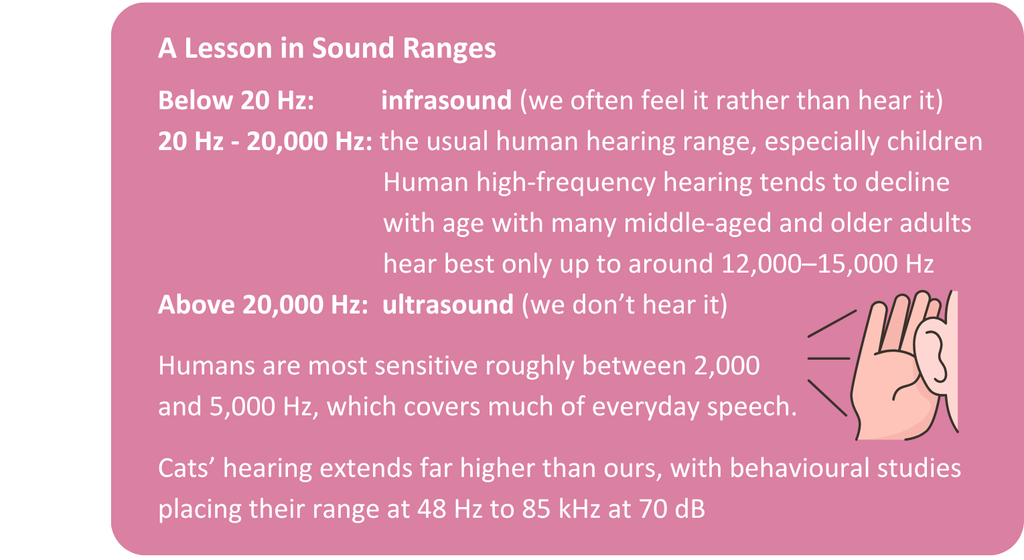
Sound is measured in hertz (Hz), which simply counts how many vibrations happen per second. Low rumbles are low-hertz (your HVAC, refrigerator, or that mysterious basement drone), while squeaky sounds are high-hertz (a kettle whistling, a mouse squeaking, a cat deciding 3 a.m. is an excellent time for parkour).
Young humans can generally hear up to about 20,000 Hz (20 kHz), though that ceiling drops as we age. Sorry about that.
Cats, on the other hand, can hear from roughly 48 Hz up to 85,000 Hz (85 kHz) under controlled testing conditions, which is one of the broadest hearing ranges among mammals! Their lower limit is close to ours, but the upper limit is another story: think glass-breaking soprano, then add a couple of octaves of very squeaky keys you didn’t know the piano had.
By the way, cats even out-hear dogs at the top end, which is a handy fact to deploy at the next dog-lover dinner party. You’re welcome. 🙂
Why Would a Cat Need That?
Two words: dinner and mice.
Many small rodents communicate and squeak in the ultrasonic range, so a cat that can hear those sounds has a serious hunting advantage. Your cat’s hearing was not designed for appreciating your playlist. It was designed for detecting the faint, high-pitched rustle of lunch.
That doesn’t mean your cat is constantly being blasted by ultrasonic chaos. Hearing a frequency and being bothered by it are different things. But it does mean your cat’s version of “quiet” includes a lot of material yours does not.
An Independent Satellite Dish on Each Side
The hardware matters as much as the range. Each cat ear is a funnel-shaped dish (the pinna) that collects sound and channels it inward. Cats have about 32 muscles controlling each outer ear, allowing them to rotate each ear independently, often through a very wide arc, and aim it toward a sound without turning their head. Humans have around six vestigial ear muscles, which mostly allow some of us to wiggle our ears at parties.
The result is impressive sound mapping. A cat can use the timing and intensity differences between its two ears to locate a sound with remarkable precision. Next time one ear points at the cupboard while the other points at you, that’s your cat multitasking: monitoring the mouse-shaped mystery and your suspicious behaviour.
Those funnel-shaped outer ears also help amplify and direct sound. Cats can detect faint high-frequency sounds at levels far below what humans can perceive, especially around their most sensitive frequencies.
Decibels Speak Volumes
Hertz measures pitch. Decibels measure loudness.
The human hearing threshold is conventionally set at 0 dB which is the faintest sound an average young human can detect under ideal conditions. Cats can detect some sounds at negative decibel levels, particularly in the high-frequency range where their hearing is most sensitive. Around 8,000 Hz, studies place feline thresholds well below 0 dB.
Translation: a sound that is technically present but effectively silent to you may be clearly detectable to your cat.
That does not mean every sound is painfully loud to your cat. At low frequencies, cats and humans have fairly similar sensitivity. But in the higher ranges, especially around 4,000–8,000 Hz and above, cats are dramatically better at picking up quiet, high-pitched sounds.
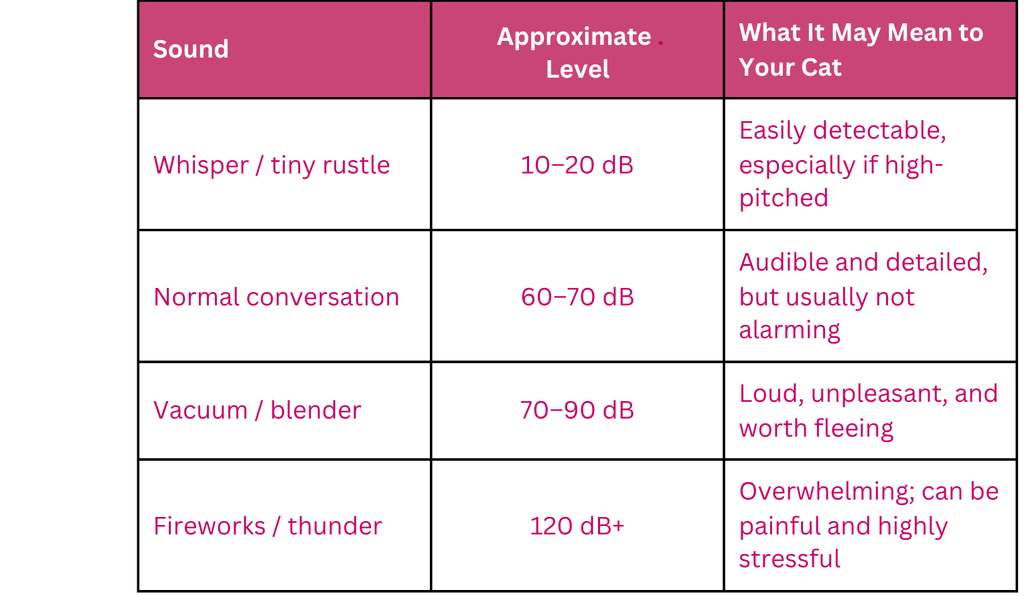
A cat can tolerate ordinary household conversation, but sudden loud noises, like vacuums, blenders, fireworks, construction, are a whole other ballgame. And because cats hear high frequencies so well, a device emitting a faint electronic whine may be much more noticeable to them than to you.
That said, we should be honest: cats can hear these frequencies, but direct research showing that common household electronics stress cats is still limited. Saying that these sounds “may bother” is more accurate than that they “definitely do bother” Max or little Fluffy. Still, it’s worth considering that some mysterious hiding, restlessness, or avoidance could have a soundscape component.
Where the Noise Hides
Many everyday devices produce sound at frequencies we can’t hear but cats potentially can. The usual suspects include:
- Phone and laptop chargers and power adapters
- LED dimmer switches and some LED bulbs
- Ultrasonic pest repellers designed to be unpleasant to small animals, and BTW, your cat is, inconveniently, a small animal
- Motion sensors and some alarm systems
- Some humidifiers and robot vacuums
Think about it from your cat’s perspective. A device you cannot hear may be producing a faint, high-pitched hum. Your cat can detect it, but cannot tell whether it is dangerous, whether it will continue, or whether it is about to get louder. Sometimes the simplest response is to leave the room.
From the outside, to us, that might look like hiding, restlessness, jumpiness, avoiding one corner of the house, or even a sudden swat that seems to come from nowhere. Of course, behaviour changes can have many causes, including pain and illness, so a vet check always comes first. But if the cause remains mysterious, the soundscape of your home is worth a thought.
My own cats illustrate this nicely. Most of them used to treat The Long-Necked Suction Monster (aka my vacuum) as a clear signal to EVACUATE IMMEDIATELY. Impending incoming life-threatening terror is coming our way. Lila, however, decided long ago that this particular noisy human contraption was harmless. And a couple of the others have since learned from watching her remain unbothered, even nonchalant. Cats can learn by watching others, or even more systematically through desensitization and counterconditioning (gradually pairing a feared sound with safety and something good)…but that is very much another article.
(Fireworks and thunder are a different kind of noise problem – one that unsurprisingly can cause huge stress. The sudden, loud, and impossible to predict noise from these two, and how to cope, actually deserves its own discussion too…one I promise to tackle in a separate dedicated article down the line!)
But What About Music?
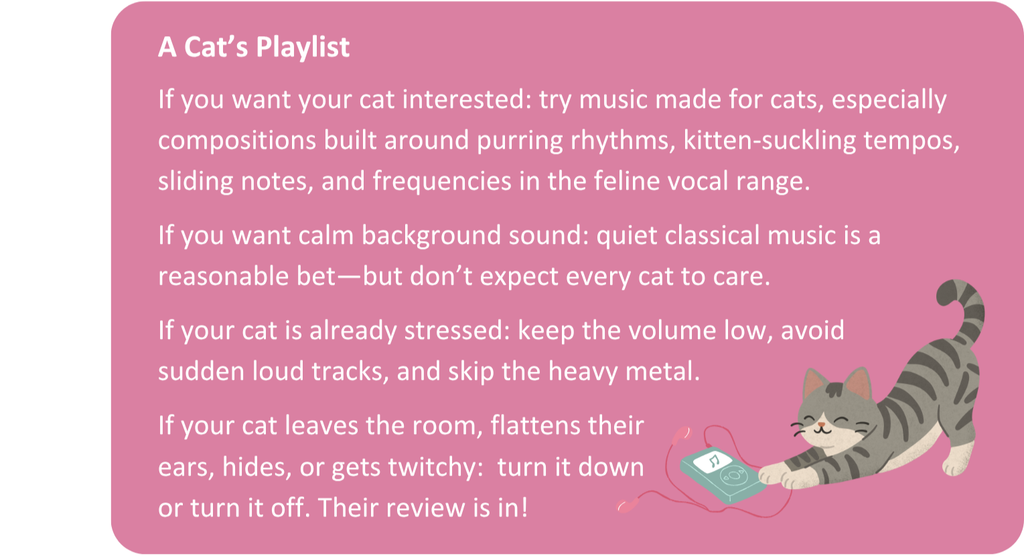
Here’s the fun twist: cats may not care much about our music, but they can respond to sound designed with their ears and communication style in mind. In a study of 47 cats, researchers compared human classical music with “cat music” composed using feline-friendly features: frequencies similar to cat vocalizations, sliding notes, and rhythms inspired by purring and kitten suckling. The cats showed significantly more positive interest in the cat-specific music than the human classical selections: approaching the speaker, rubbing against it, and orienting toward it.
So no, your cat is probably not secretly moved by Mozart. But a composition built around purrs, suckling rhythms, and cat-range frequencies may actually get their attention.
What about classical music, pop, and heavy metal? Studies of cats undergoing veterinary procedures or anaesthesia found a pattern: classical music was associated with the calmest physiological measures, pop was intermediate, and heavy metal produced the highest values for measures such as heart rate, respiratory rate, blood pressure, and pupil dilation.
Before you rush to replace your entire household soundtrack with Vivaldi, though, keep the caveat in mind: those studies mostly involved cats in clinical or anaesthetized settings, not cats lounging on your sofa judging your taste.
The safest conclusion is not “classical music magically soothes all cats,” but rather:
- Cat-specific music has the best evidence for attracting feline interest and may reduce stress in some settings.
- Classical music may be a reasonable, low-stakes background choice.
- Loud, intense music—especially heavy metal at high volume—is probably not the vibe for a cat already side-eyeing the vacuum.
When the Volume Is Off
After a whole article about a house that’s too loud, here’s the plot twist: for some cats, it’s completely silent.
Deafness in cats is most strongly linked to a white coat, caused by the dominant white gene (W). The same gene that switches off pigment in the fur can also affect pigment cells in the inner ear; without them, parts of the inner ear can degenerate.
What about blue eyes? Blue eyes do not cause deafness. But in white cats, blue eyes can be a clue that the W gene has also affected pigment elsewhere. In older studies of mixed-breed white cats, roughly 17–22% of cats with no blue eyes were deaf, about 40% of cats with one blue eye were deaf, and roughly 65–85% of cats with two blue eyes were deaf.
That does not make every blue-eyed white cat deaf, and it does not mean a white cat with yellow or green eyes is guaranteed to hear perfectly. More recent work in purebred white cats has found lower overall rates of deafness, so treat these numbers as useful context, not a diagnosis.
Some cats are also deaf in only one ear. These cats can react to sound so normally that even their humans may not notice.
Now, being curious this led me down another path, because, when humans lose one sense, typically other senses become more sensitive, sharper. What about cats? Well, research by one team (see the Stephen Lomber reference below) found that deaf cats were better at locating visual targets, especially in the far periphery, and at detecting movement. Their brains appeared to repurpose some auditory processing areas for visual tasks, similar to what happens to us. Potentially pretty cool…though a later study found surprisingly little difference in the visual cortex itself, suggesting the advantage may lie less in “seeing better” and more in using visual information efficiently to find and reach a target. So the verdict is still out. Losing hearing does not necessarily simply mean the other senses become superpowers in cats.
So… What?
Your cat lives in a richer, higher, and sometimes noisier world than you do. For a few cats, it is a quieter one.
Either way, a lot of what looks like “just cat behaviour” may be a cat responding to a world we simply cannot hear. Next time your cat stares at a blank wall, you may not be able to hear what they’re hearing.
But now you know: it’s probably not a ghost.
Next in Cat Senses 101: whiskers, and why they’re so much more than facial decoration.
_________________________________________
SOME RESEARCH/READING SOURCES
Cornell Feline Health Center. White cats and blindness/deafness. Cornell University College of Veterinary Medicine. https://www.vet.cornell.edu/departments-centers-and-institutes/cornell-feline-health-center/health-information/feline-health-topics/ask-elizabeth-white-cats-and-blindnessdeafness
Geigy, C. A., Heid, S., Steffen, F., Danielson, K., Jaggy, A., & Gaillard, C. (2007). Does a pleiotropic gene explain deafness and blue irises in white cats? The Veterinary Journal, 173, 548–553. https://doi.org/10.1016/j.tvjl.2006.07.021
Hampton, A., Ford, A., Cox, R. E., Liu, C.-C., & Koh, R. (2020). Effects of music on behavior and physiological stress response of domestic cats in a veterinary clinic. Journal of Feline Medicine and Surgery, 22, 122–128. https://doi.org/10.1177/1098612X19828131
Heffner, R. S., & Heffner, H. E. (1985). Hearing range of the domestic cat. Hearing Research, 19, 85–88. https://doi.org/10.1016/0378-5955(85)90100-5
Lomber, S. G., Meredith, M. A., & Kral, A. (2010). Cross-modal plasticity in specific auditory cortices underlies visual compensations in the deaf. Nature Neuroscience, 13, 1421–1427. https://doi.org/10.1038/nn.2653
Mira, F., Costa, A., Mendes, E., Azevedo, P., & Carreira, L. M. (2016). A pilot study exploring the effects of musical genres on the depth of general anaesthesia assessed by haemodynamic responses. Journal of Feline Medicine and Surgery, 18, 673–678. https://doi.org/10.1177/1098612X15588968
Mitzelfelt, T., Bao, X., Barnes, P., & Lomber, S. G. (2023). Visually evoked potentials (VEPs) across the visual field in hearing and deaf cats. Frontiers in Neuroscience, 17, 997357. https://doi.org/10.3389/fnins.2023.997357
Snowdon, C. T., Teie, D., & Savage, M. (2015). Cats prefer species-appropriate music. Applied Animal Behaviour Science, 166, 106–111. https://doi.org/10.1016/j.applanim.2015.02.012