
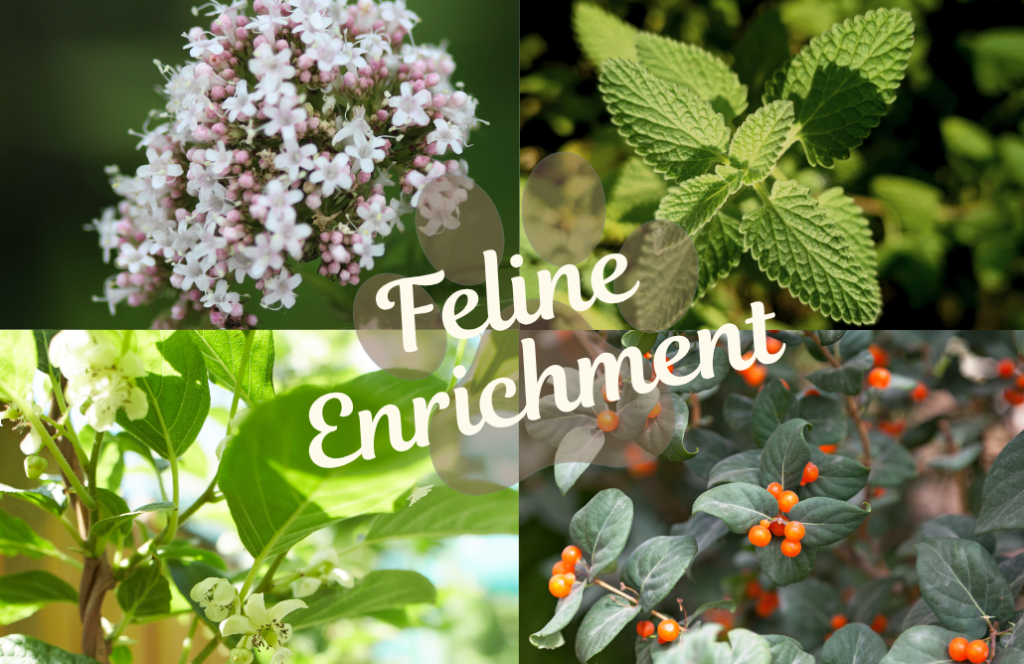
How Catnip, Valerian, Silvervine, and Honeysuckle Can Enrich Your Cat’s Life and Ease Their Stress
If you’ve read my previous article about catnip, valerian, and silvervine, you already know that these are not herbal treats every cat is programmed to love. For the kitties who are genetically wired to react to their aromatic compounds, however, they can be a versatile, lower-risk way to enrich a cat’s life, especially when used thoughtfully and intentionally. The four plants are not limited to enrichment alone, though. All four can also potentially be a helpful option for stress relief, and for some shy or anxious cats, a small dose of the right scent can make the environment feel a little more inviting.
Enrichment: Making Play More Fun
Enrichment is anything that helps your cat use their body, brain, and senses in a way that feels engaging and rewarding. Catnip, valerian, silvervine, and even Tatarian honeysuckle can all be used as olfactory enrichment, meaning they make the environment more interesting through smell.
Of course, for these to actually work as enrichment, you first have to figure out which plant catches your furry protégé’s attention. In other words: which one does your cat react to? These herbs are definitely not one-size-fits-all, so finding the one that works will take a bit of trial and error. You may need to try each one separately to see what “takes.”
And honestly, most cat owners know this routine already. We buy a toy with great hope, bring it home with excitement, and then watch our cat stare at it as if we have personally insulted their standards. Sometimes they love it. Sometimes they walk away with calm, withering indifference. Cats are excellent at making us question our shopping choices.
But if you do find one your cat likes, you’re in business.
And if your cat doesn’t seem keen on any of them, don’t despair. There are plenty of other forms of enrichment you can use: food puzzles, hiding boxes, vertical spaces, window perches, and hunting games with toys. You can still be very creative without these herbs.
For those who have hit gold with at least one of them, here are some ground rules:
- Use only when supervised. Current evidence suggests that, when used intermittently and voluntarily, catnip and silvervine are safe enrichment tools, as is the lesser-known Tatarian honeysuckle. Valerian also appears benign in short-term exposure. Still, it’s best to supervise use, just as you would with wand toys or any other enrichment item.
- Keep exposure time-limited. Short sessions help prevent overexposure and keep the plant novel.
- Expect it to last about 5 to 20 minutes, depending on the cat. You may see sniffing, rolling, rubbing, scratching, batting, licking, or a burst of zoomies.
- Rotate the herbs that work for your cat, and vary where and how you use them to keep things interesting.
Now, let’s move on to some ideas for how you can use them at home.
Toys
One of the easiest ways to add a little surprise for your fluffy companion is through toys that either contain the herb or are scented with it. For example, you can use a catnip toy, rub dried catnip onto a regular toy, or lightly spray a toy with a non-alcohol-based valerian extract. With silvervine, you can even offer a stick as the toy itself, which adds a little extra pizzazz to your cat’s day.
What’s interesting from the research is that adding a cat’s preferred odour to a stationary toy can increase interaction more reliably than adding it to a moving one. In other words, a stuffed toy mouse or fish may become far more exciting when it carries the right scent.
Scratching Posts and Trees
One thing you can do, to add something different for your kitties to explore, is to rub a small amount of catnip, silvervine, or valerian powder on some of your cardboard scratchers or sisal posts. You can also spray a catnip – or silvervine-based spray on scratching surfaces or beds to encourage use.
Every so often you can also lightly sprinkle one of the plants in powder form on different levels or favourite perches can turn them into scent stations your cat can explore.
Enrichment Mats and Puzzle Toys
A tiny amount of catnip, silvervine, valerian, or honeysuckle can also be added to foraging mats or puzzle boxes to make the search more rewarding.
A 2025 study found that cats strongly preferred toys scented with catnip or silvervine over unscented toys, and they spent more time interacting with them. That is a simple way to boost mental stimulation without needing expensive gadgets.
Tatarian honeysuckle is a lesser-known but validated alternative that can be offered on scratching posts or toys, especially if a cat doesn’t respond to catnip or silvervine. The plant can elicit strong catnip-like responses in some cats, including rubbing and rolling, and may be especially attractive to toy-oriented or scratching-board-loving cats.
You can think of it as another option in the enrichment toolkit rather than a replacement for the better-known herbs.
But enrichment is only part of the story, because these same scents can also be useful when a cat needs comfort, confidence, or a calmer experience.
Helping with Stress and Calm Moments
These plants are not sedatives, but they can help diffuse stress and make high-tension situations feel more manageable, especially when used in a calm, predictable way.
Here are some evidence-informed ways to use them:
- Before and after vet visits or car rides: Lightly rub a catnip- or silvervine-scented toy or blanket in the carrier a few days before the trip so the smell becomes familiar and positive. Offer a small sniff on arrival at the clinic if your cat is not already fearful.
- During changes at home: When moving furniture, introducing new people, or adding a new pet, place a scented toy or mat in a familiar safe zone to give your cat a positive sensory anchor.
- For shy or anxious cats: A small, controlled whiff on a trusted bed or tunnel may help some cats feel more engaged with their environment, as long as they are not overwhelmed.
Importantly, these odours should never be forced on a stressed cat. If your cat runs away, hides, or shows signs of fear such as pinned ears, hissing, or growling, remove the scent and try again another day or in another context.
These plants work best when they are offered as an invitation, not an expectation.
_________________________________________
Sources
Abramson, Charles, et al. “The Use of Silver Vine (Actinidia Polygama Maxim, Family Actinidiaceae) as an Enrichment Aid for Felines: Issues and Prospects.” American Journal of Animal and Veterinary Sciences. vol. 7, no. 1, 2012, pp. 21-27.
Bol, Sebastian, et al. “Responsiveness of cats (Felidae) to silver vine (Actinidia polygama), Tatarian honeysuckle (Lonicera tatarica), valerian (Valeriana officinalis) and catnip (Nepeta cataria).” BMC Veterinary Research. vol. 13, no. 70, 2017, pp. 1-15.
Uenoyama, Reiko, et al. “Assessing the safety and suitability of using silver vine as an olfactory enrichment for cats.” iScience. vol. 26, no. 10, 2023, article 107848, pp. 1–16.
Webberson, Emily, et al. “Sniffing for fun: Evaluating the effect of olfactory enrichment on cats’ toy preference and interaction.” Applied Animal Behaviour Science. vol. 281, 2025, article 105905, pp. 1–12.2, pp. 1–16.