If you’ve lived with cats for any length of time, you already know this: buying something your cat is “supposed” to love is…NOT guaranteed.
Catnip, for example, has an almost legendary reputation. But, one cat will roll around like they’ve just discovered pure joy. Another will sniff it, pause, and give you a look that clearly says, “You woke me up for this?!” That doesn’t mean catnip is overrated. It means cats, like people, don’t all experience the world the same way. A useful comparison is cilantro. Some people taste something fresh and citrusy. Others taste soap. Same plant, different wiring. The difference comes down to genetics and how the brain interprets specific compounds.
Cats are doing something very similar with the scent of catnip, which is where valerian and silvervine can be good “go-to’s”. Let’s take a look at all three, starting with the classic, catnip.
Catnip: The (Not-So-Universal) Classic
Catnip (Nepeta cataria) is a member of the mint family, and it’s easily the most famous cat “recreational” plant and the one everyone knows. It contains a compound called nepetalactone, which becomes active when the plant is crushed and releases its scent.
Cats don’t need to eat it. They smell it, and that scent travels through the olfactory system to parts of the brain involved in emotion and behaviour. What you often see next is that familiar burst of activity: rolling, rubbing, zooming, dramatic flopping.
It looks a bit chaotic, but it’s actually short-lived and self-limiting. Most cats are “done” within about 5–15 minutes, followed by a reset period where it just stops working for a while.
Now, here’s the part people often miss: not all cats respond. In fact, roughly a third of cats show little to no reaction at all. Another interesting fact is that kittens often don’t respond to catnip until they’re a few months old. And even among those adults who do respond to this herb, intensity varies a lot. For example, among my current clan, five of them go absolutely nuts over it while one will come down and sniff and then turn away, unphased. You can see the “meh” in her eyes as she moves on.
So, to summarize: with catnip it’s not about preference – it’s actually about genetics. If the right receptors aren’t there, catnip simply doesn’t register.

Valerian: The Funky Smelling One
Enter valerian. Valerian (Valeriana officinalis) is a flowering plant better known as a calming herb for humans. Cats did not get that memo. For those who react to it, valerian can be pretty darn stimulating.
Here, for those science geeks like me, the key compound here is actinidine (which also shows up in silvervine, by the way). Like catnip, it triggers a similar scent-based response, but the overall smell is stronger, heavier, and to be honest, not especially pleasant to most people. (See, people respond differently to smells too!)
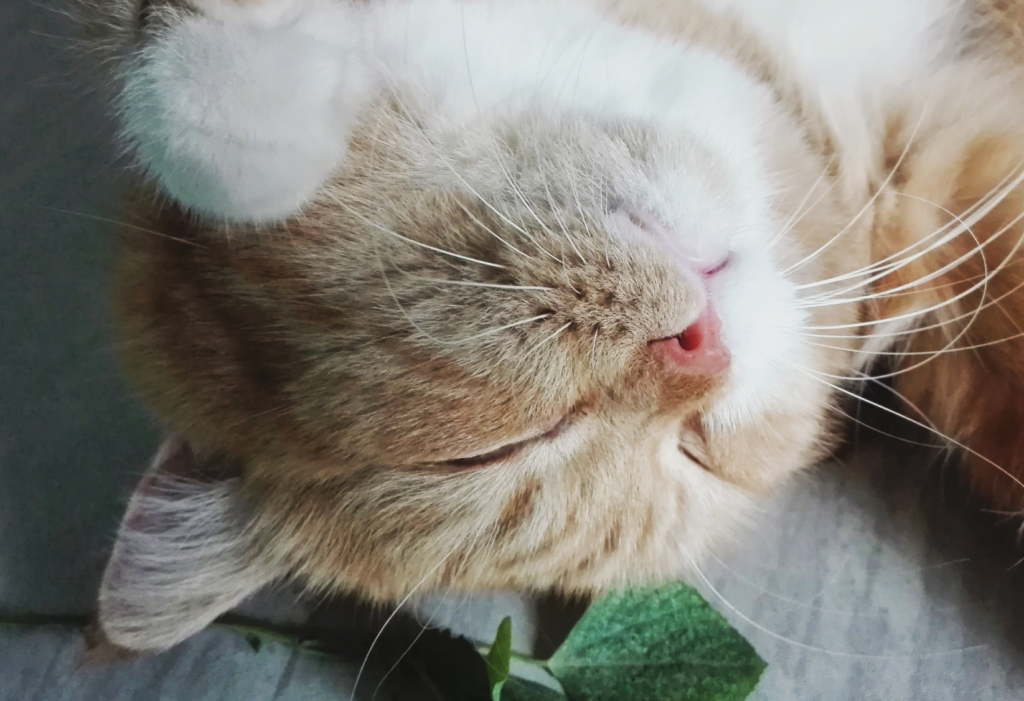
Many cats disagree on the smelliness factor. Some respond with playful energy similar to catnip. Others go a bit further with much more intense rolling, more fixation, sometimes what looks like mildly chaotic enthusiasm. And some cats? Absolutely nada. Immediate rejection. Among my six I’ve lucked out: ALL of them go bonkers for it!
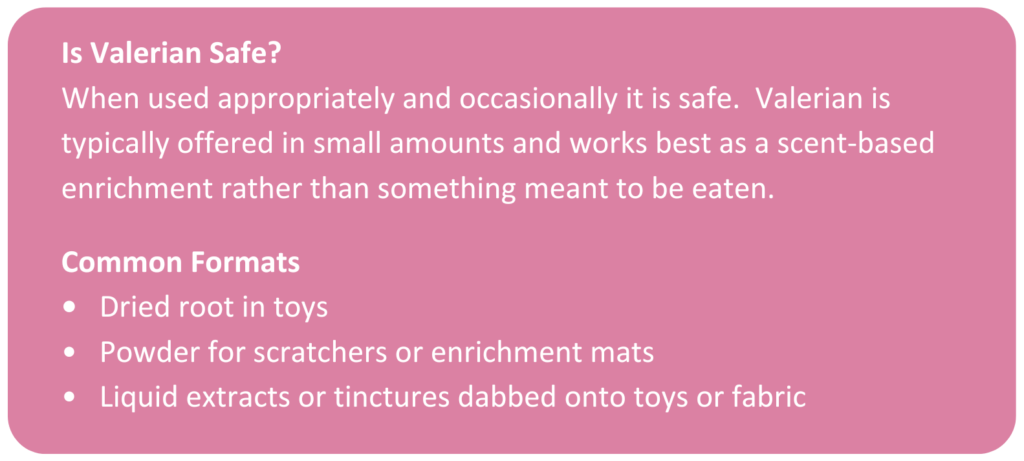
Where does the discrepancy come from? Again, as with catnip, it comes down to individual sensitivity and differences in scent receptors. However, valerian tends to “hit” a different subset of cats than catnip does, which is why it can be useful as an alternative. Just maybe not something you want sprinkled across your living room every day J.
Silvervine: The Overachiever
Silvervine (Actinidia polygama), also called matatabi, is where things get especially interesting.
(Matatabi, which has been used for centuries in Japan and Asia as a popular cat stimulant, is the Japanese name for this climbing vine in the kiwifruit family.)
Unlike catnip, which relies mainly on one compound, silvervine contains several active ones: nepetalactol and actinidine. In practical terms, that means it gives the cat’s nose more than one way to detect it. If catnip is a single key, silvervine is a small key ring. And that is why more cats (about 80%) tend to respond to it, including many who ignore catnip completely.
With silverine you’ll often see a full sequence of behaviours: rolling, rubbing, licking, sometimes chewing (especially with silvervine sticks), followed by a very content-looking cool-down. It can look dramatic, but like catnip, it’s short-lived and self-regulating.
Interestingly, some younger cats who don’t yet respond to catnip will react to silvervine. One likely reason is that its mix of compounds is easier for a still-developing olfactory system to detect.
But, as always with cats, there are no guarantees.

So… which one should you use?
There isn’t a single “best” option, and that can actually be the useful part because, if you are lucky like me, it can give you options (think enrichment and scent rotation).
Catnip is widely effective, easy to grow, and well understood.
Valerian works for a different group of cats and tends to produce stronger scent-driven responses.
Silvervine reaches the widest range and often succeeds where the others don’t.
One last thing: these plants aren’t magical. They’re chemical. Cats evolved to respond to certain aromatic compounds, and those responses vary because biology varies. So, trying more than one isn’t over-the-top. It’s just responding to the fact that cats are individuals with different sensory wiring.
If your cat loves one, ignores another, or rejects all three with quiet dignity from across the room, you’re not doing anything wrong.
You’re just living with a cat.
_________________________________________
Sources
Abramson, Charles, et al. “The Use of Silver Vine (Actinidia Polygama Maxim, Family Actinidiaceae) as an Enrichment Aid for Felines: Issues and Prospects.” American Journal of Animal and Veterinary Sciences. vol. 7, no. 1, 2012, pp. 21-27.
Bol, Sebastian, et al. “Responsiveness of cats (Felidae) to silver vine (Actinidia polygama), Tatarian honeysuckle (Lonicera tatarica), valerian (Valeriana officinalis) and catnip (Nepeta cataria).” BMC Veterinary Research. vol 13, no 70, 2017, pp. 1-15.
Bol, Sebastian, et al. “Behavioral differences among domestic cats in the response to cat‑attracting plants and their volatile compounds reveal a potential distinct mechanism of action for actinidine.” BMC Biology. vol. 20, no. 192, 2022, pp. 1–16.
Uenoyama, Reiko, et al. “Assessing the safety and suitability of using silver vine as an olfactory enrichment for cats.” iScience. vol. 26, no. 10, 2023, article 107848, pp. 1–16.t, and guesswork fades. Life with your little furr ball(s) becomes the easy chat it was meant to be.